


From iron to digital: how B4F is changing the rules of industrial traceability

In today's industrial landscape, every physical asset is an essential node in the value chain. Tracking where assets are, knowing their condition, who used them and when they were moved is now essential to ensure operational efficiency, safety and cost control.
But what if every asset could provide this information on its own, accurately and continuously? What if it could become an active source of data, able to tell its own story: where it is, what it has done, what condition it is in and when it will need to be replaced?
About 77% of supply chain decision-makers consider real-time traceability an essential requirement, yet only 25% say they actually use real-time tracking solutions in their operations. In practice, three out of four companies are still flying blind on shipments and assets in transit, relying on delayed or incomplete data. This limits their ability to react quickly to delays, errors or anomalies, with impacts across the entire value chain (from the warehouse to the end customer).
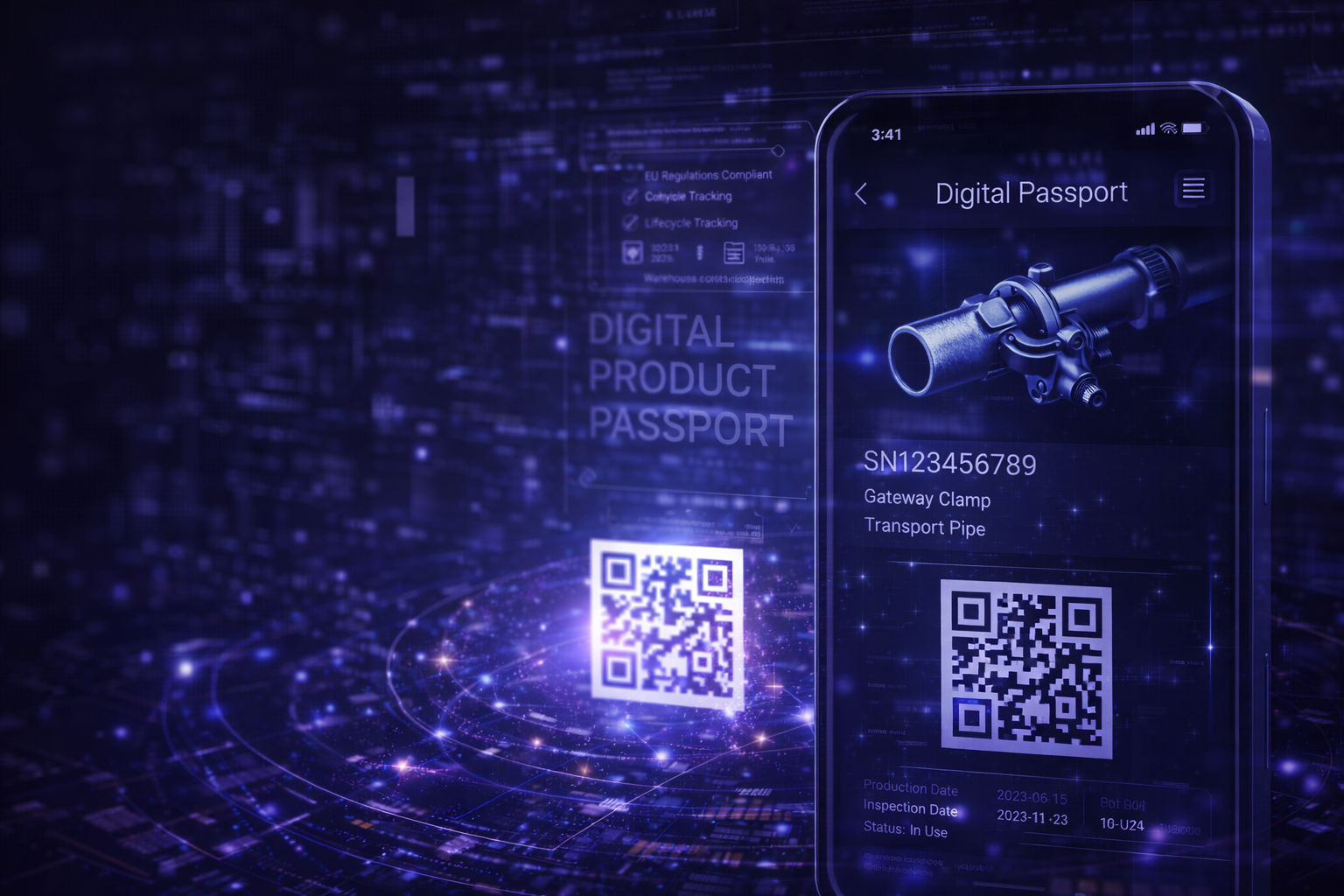
This is where B4F Digital Track comes in: the solution developed by B4F Innovation to bring traceability, automation and security to sectors such as construction, logistics and manufacturing, through a technology mix of RFID, blockchain and artificial intelligence.
The problem: fragmented management and disconnected data
In many companies, physical assets are still managed with Excel sheets, barcodes, manual processes or siloed systems that do not communicate with each other. This fragmentation creates huge inefficiencies: it is estimated, for example, that the average employee can spend up to 30% of the day (2.5 hours) just searching for and retrieving information across non-integrated systems. Spreadsheets are also notoriously error-prone (errors are found in 90% of them), yet many organizations still rely on them to track their assets.
According to several industry studies, more than 40% of European manufacturers say they lack full visibility into the lifecycle of their assets and into the operating conditions of materials along the supply chain. In logistics, the average shipping error rate is between 2% and 5%, generating returns, rework and losses, on top of reputational damage that is hard to quantify.
In highly complex sectors, such as components for the automotive and marine industries or modular construction, even a single loss of traceability can be very costly: halted orders, disrupted just-in-time chains, mass recalls and certification or safety issues.
The challenge of circulating goods
A typical case involves reusable or multi-cycle products, such as:
- Industrial gas or oxygen cylinders;
- Pressurized or special containers;
- Technical components sold or rented for construction sites;
- Mechanical systems subject to cyclical maintenance.
In these cases, it is not enough to know “where the item is”: you also need to know when it was produced, from which batch, how many times it has been used, whether it has been serviced and when it will need to be replaced. This data is often not digitalized or centralized, but scattered across paper records, legacy management systems and tribal knowledge.
The risks of managing information manually
The lack of end-to-end traceability is not just a management limitation. It is a real risk:
- For efficiency, because it slows down processes and creates waste;
- For safety, because uncontrolled or non-compliant goods may be reused;
- For sustainability, because unnecessary trips, unplanned maintenance and wasted resources multiply;
- For compliance, because it becomes hard to guarantee audits, certifications and sector regulations (e.g., ISO, CE, metrological checks).
Why processes need to be digitalized
Companies that want to stay competitive in the global market must overcome data fragmentation and adopt advanced digital traceability that can:
- Integrate the monitoring of assets and products into a single platform;
- Provide reliable real-time data on location, condition, usage and compliance;
- Automate notifications, inspections, progress reports and quality checks;
- Connect the physical and digital worlds with RFID tags, the cloud and blockchain.
This is the context in which B4F Digital Track was created: a concrete, scalable answer that turns every industrial asset into a smart, traceable object, able to communicate its status along the entire supply chain, from first use to the last mile.
Want to turn every asset into a traceable source of value?
Switch to smart, certified and automated traceability.
Find out how B4F Digital Track can transform the management of your industrial assets.
Talk to our team
Send us your request and our team will get back to you within 24–48 hours.